Authenticity Is The New Bullshit

Introduction
Summary
Creativity
Summary
Mastery
Summary
Meaning
Summary
Random Advice
Summary
Introduction
Summary
Creativity
Summary
Mastery
Summary
Meaning
Summary
Random Advice
Summary
When I was attending University in the 1980’s, I went and got a suit-and-tie summer job in a large office in downtown Houston, doing white-collar drudgery for a big oil company.
It sucked.
That summer, I was also in a painful, Nowheresville relationship with a lovely young woman. That also sucked.
That year my college grades sucked, as well. As did my social life and financial situation.
The whole year sucked, frankly. I sucked, my job sucked, my love life sucked, my situation sucked. Sucked, sucked, sucked.
Two decades later, I’m frankly still quite traumatized by it. Ha.
Since then, I’ve spent a great deal of time and energy trying to figure out how to keep myself out of jobs, careers, relationships and situations that suck, how to keep life from sucking in general.
Learning how to NOT SUCK is one of our most important pursuits.
Sucking is the enemy. Indeed.
So when I was recently asked to give a talk to marketing students at Unibe University in the Dominican Republic, I decided that helping them learn “The Art Of Not Sucking” would be far more useful for them, or at least, welcome, than the usual textbook marketing stuff they have to read on a daily basis.
Let’s face it, “Success” and “Failure” are still too far away in the distant future to be truly tangible most young adults, they’ve still got way too much in front of them. That was certainly true in my case, and every other case I knew well at the time.
However, leaving the comfy surroundings of college life and hitting the adult world and finding out right away that you suck at everything? That everything is going to suck from now on?
“What if I suck?” That’s a real burning issue.
With graduation looming, that’s what college seniors are REALLY worried about. I speak truth.
College kids aren’t afraid of failing, they’re afraid of sucking.
The talk I gave to the kids was so much fun, I thought I’d spread the love some more, by turning my notes into a little e-book and sharing it with everybody. This is it. I hope it’s helpful; thanks for taking the time to download it.
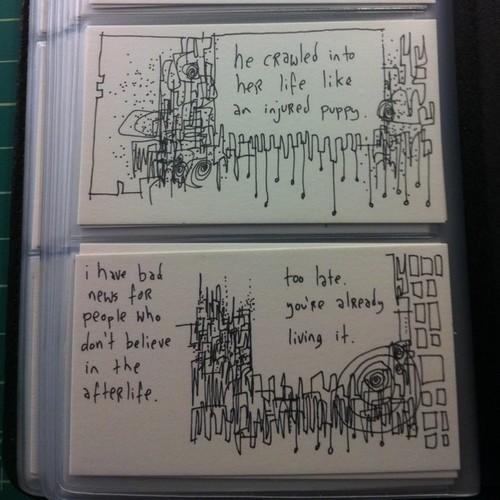
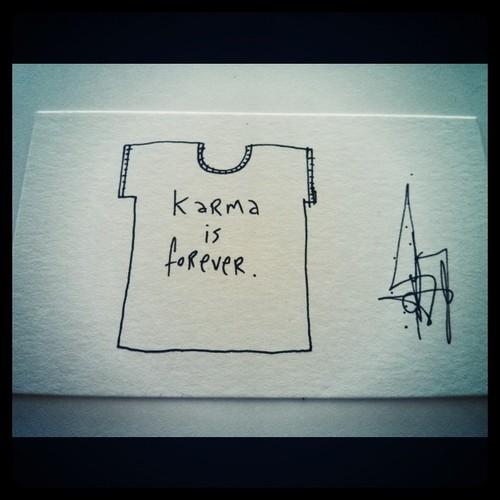
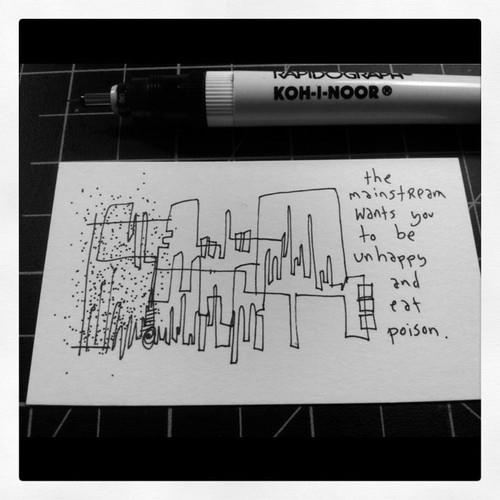
[NB: Many of the themes below were covered before, in both my blog and my other books, some points more than others. If you experience déjà vu, that is why. Secondly, to make it more fun to read, I did my usual thing i.e. randomly inserted some of my favorite recent cartoons in the mix, similar to how The New Yorker inserts unrelated cartoons into their pages.]
"SUCCESS IS EASY"
Don’t let the drama queens and marketing dorks fool you, success is actually pretty easy… or at least, simple. It basically has four elements:
Of the four, "Don't suck" is the most daunting. The other three are fairly straightforward.
"Word hard" and "Be nice" are just a matter of personal choice. Having a great product is just a matter of having enough perseverance, and a little bit of luck.
Whereas "Don't suck" is really, really, hard for most people. It's the one most of us trip over. Especially the drama queens and marketing dorks.
To be successful, first you need to learn how to not suck.
You need to learn The Art Of Not Sucking.
After that, the rest should take care of itself.
THE THREE ELEMENTS OF NOT SUCKING
For sake of brevity, I narrowed “Not Sucking” down to three elements. “Not Sucking” is much easier with these three, much, much harder without them:
Creativity
Summary
Mastery
Summary
Meaning
Summary
There's also a fourth section,
Random Advice
Summary
which is also the longest section. It seemed like a good idea at the time. And with that, my friends, let the adventure begin!
20. We're All Connected.
Summary
21. The Old Jobs Simply Aren't There Anymore.
Summary
22. It's Not Enough to be Good at Doing the Work, You Have to be Good at Creating Your Own Platform.
Summary
23. Own Something.
Summary
24. Everybody is Just as Scared as You.
Summary
25. How to be Successful: Find Out What Matters, Find Out Who Matters, Then Carry On.
Summary
26. It's Either a Platform, or It's Something That Will Eventually Drown You.
Summary
27. Have One Eye Looking Out, One Eye Looking In.
Summary
28. Be Nice. Be Helpful. The Alternatives Won't Make You Happy.
Summary
29. You Were Born to be Happy.
Summary
30. Fail Like a Child.
Summary
31. You Must Discover What Your Real Joy is.
Summary
32. Small Art Can be Just as Powerful as Big Art.
Summary
33. Make Every Work of Art like it's Your Last.
Summary
34. "My Work Doesn't Belong in Galleries, it Belongs in the Office..."
Summary
35. "Only Connect."
Summary
36. You Can't Plan for Creativity. You Can Only Plan to do the Work.
Summary
37. The Era of Career-on-Autopilot is Over.
Summary
38. Find the Holy in Everyday Activity.
Summary
39. "Culture Hacking" is the Next Trillion-Dollar Industry.
Summary
40. Never Go Mainstream.
Summary
41. People Must Treasure You.
Summary
42. Blogs are like Hammers.
Summary
43. Beware of Guru-Nomics.
Summary
44. How to Really Use the Internet.
Summary
45. Learn How to Present.
Summary
46. Avoid Drama.
Summary
47. Keep it New. Keep it Fresh.
Summary
48. To My Jaded Veteran Blogger Friends: Get Over Yourselves.
Summary
49. Winning is for Losers.
Summary
5o. Beware of the Big Moments.
Summary
51. Avoid Frivolous Complexity.
Summary
52. The Product Doesn't Get to Kick Ass Until the User Kicks Ass, First.
Summary
53. Food is Medicine. So are People.
Summary
54. Follow Your Bliss.
Summary
55. Make Sure to Leave a Meaningful Body of Work Behind.
Summary
56. All Art is Religious Art.
Summary
“Creativity” just means the ability to come up with original, useful ideas. It could be through the art of painting, starting a company or designing car engines. It could be just an innovative way of how you do your nine-to-five job at the office or how you make coffee for your
customers at Starbuck’s.
Thought “Creativity” is a messy, loaded, overused word, it’s also what our brains were actually designed for.
Creativity is who we are at our deepest, biological level. That’s why everybody is given a box of crayons in Kindergarten. This is what allowed our ancestors to discover how to make a fire, paint the occasional Sistine Chapel or learn that the earth was round.
People who want a more thorough overview of creativity should perhaps read my first book, “Ignore Everybody”, but here are some general pointers to get you started:
1. Climb Your Own Mount Everest
Summary
2. "Learn How to Invent"
Summary
3. Don't Wait to be Told What to Do, Don't Wait for Permission
Summary
4. Don't Wait to be Discovered
Summary
5. "Good Ideas Have Lonely Childhoods."
Summary
6. Avoid the Watercooler Gang
Summary
7. Have Boundaries
Summary
8. "Be Secret, and Exult" –W.B. YEATS
Summary
9. Learn from Jiro
Summary
10. Circumvent Your Own Limitations
Summary
11. Mastery is Boring
Summary
12. There is No Secret Sauce
Summary
13. Your Brain is a Filter. Use It Wisely.
Summary
14. Marketing is Important
Summary
15. A Successful, Meaningful Life Makes a Lot of "Art"
Summary
16. Be Nice. Karma is More Ruthless Than You Are.
Summary
17. You Will Die.
Summary
18. Love is the Only Thing that Matters, in the End.
Summary
19. Anything Worth Doing Will Cost You Your Life.
Summary
Like I said in “Ignore Everybody”, everybody has their own private Mount Everest they were put on this earth to climb.
Some kind of personal heroic quest, as it were.
For me, that meant getting good as a cartoonist. For others, it could have something to do with starting a business, getting a PhD in Linguistics, becoming the most kick-ass divorce lawyer in town or learning to play violin. It doesn’t matter what it is, what matters is that it’s a manifestation of our higher selves; it’s the one big deed that we want to be remembered for. It’s the thing you need to do if you want to eventually take leave of this world, knowing you managed to play your best game.
Most people don’t try to climb their own Mount Everest, or at least, they give up on it far too early. They get busy with jobs, family, TV, shopping, eating tacos, drinking beer and all the usual stuff.
And most people who end up never climbing it, do so because they didn’t realize it was there in the first place. Admitting that it’s there is a scary and uncertain business. Admitting that it’s there is half the battle.
This is the advice I witnessed the esteemed CNN news correspondent, David Gergen give a small group of young entrepreneurs at a talk in Boston not long ago:
“Learn how to invent, that’s the only advice I really have to give you.”
Simple? Yes. Easy? No.
Gergen is a very clever and accomplished fellow. He could have suggested much more that evening; he basically chose not to. Why was that?
Because once you learn how to invent, the rest of the world’s opportunities open up to you in Glorious Technicolor. If don’t learn, there’s not much anyone can do to help you, except maybe help you lift some random rock to crawl under.
Harsh but true.
The good news is, you don’t need to be Albert Einstein, Picasso or some other god-genius to invent something. You can be anybody, and you can do it anywhere. On the job or after hours. Working as a cog in a big corporation or painting unknown masterpieces in a garret. Scale doesn’t matter, mindset matters. Decision matters.
To invent means to create a thing of beauty, large or small, in a place where beauty was lacking.
The world will always conspire to make you less than you are. Even the well-intentioned parts of it. The question is, do you let it?
You have to decide.
Generally, the real world doesn’t go out of its way to tell you to go create something useful and/or meaningful. Usually, it just tells you to keep your nose down and don’t rock the boat. The fact that the latter could quickly destroy your soul in the process is irrelevant to them.
So I’m afraid it’s you who must take the initiative; I am equally afraid that it’s you who has to take the heat if things go terribly wrong. The good news is, things don’t always go wrong forever. And a few bumps along the way is the best education known to man. The only alternative is crawling under that aforementioned rock. And you don’t want that. No.
Content
Content
Content
Content
Content
Content
Content
Content
Content
Content
Content
Content
Content
Content
Content
Content
Content
Content
Content
Content
Content
Content
Content
Content
Content
Content
Content
Content
Content
Content
Content
Content
Content
Content
Content
Content
Content
Content
Content
Content
Content
Content
Content
Content
Content
Content
Content
Content
Content
Content
Content
Content
Content