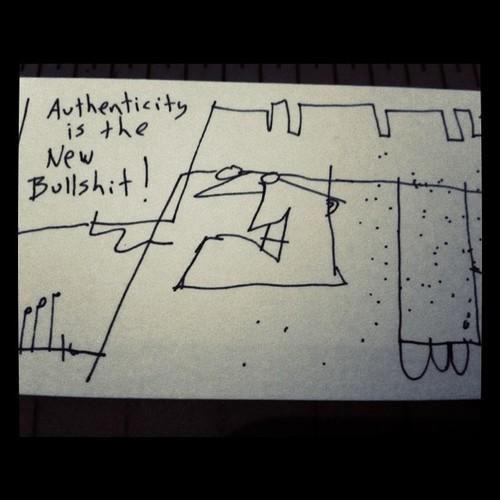
Authenticity Is The New Bullshit

Introduction
Summary
Creativity
Summary
Mastery
Summary
Meaning
Summary
Random Advice
Summary
Introduction
Summary
Creativity
Summary
Mastery
Summary
Meaning
Summary
Random Advice
Summary
When I was attending University in the 1980’s, I went and got a suit-and-tie summer job in a large office in downtown Houston, doing white-collar drudgery for a big oil company.
It sucked.
That summer, I was also in a painful, Nowheresville relationship with a lovely young woman. That also sucked.
That year my college grades sucked, as well. As did my social life and financial situation.
The whole year sucked, frankly. I sucked, my job sucked, my love life sucked, my situation sucked. Sucked, sucked, sucked.
Two decades later, I’m frankly still quite traumatized by it. Ha.
Since then, I’ve spent a great deal of time and energy trying to figure out how to keep myself out of jobs, careers, relationships and situations that suck, how to keep life from sucking in general.
Learning how to NOT SUCK is one of our most important pursuits.
Sucking is the enemy. Indeed.
So when I was recently asked to give a talk to marketing students at Unibe University in the Dominican Republic, I decided that helping them learn “The Art Of Not Sucking” would be far more useful for them, or at least, welcome, than the usual textbook marketing stuff they have to read on a daily basis.
Let’s face it, “Success” and “Failure” are still too far away in the distant future to be truly tangible most young adults, they’ve still got way too much in front of them. That was certainly true in my case, and every other case I knew well at the time.
However, leaving the comfy surroundings of college life and hitting the adult world and finding out right away that you suck at everything? That everything is going to suck from now on?
“What if I suck?” That’s a real burning issue.
With graduation looming, that’s what college seniors are REALLY worried about. I speak truth.
College kids aren’t afraid of failing, they’re afraid of sucking.
The talk I gave to the kids was so much fun, I thought I’d spread the love some more, by turning my notes into a little e-book and sharing it with everybody. This is it. I hope it’s helpful; thanks for taking the time to download it.
[NB: Many of the themes below were covered before, in both my blog and my other books, some points more than others. If you experience déjà vu, that is why. Secondly, to make it more fun to read, I did my usual thing i.e. randomly inserted some of my favorite recent cartoons in the mix, similar to how The New Yorker inserts unrelated cartoons into their pages.]
"SUCCESS IS EASY"
Don’t let the drama queens and marketing dorks fool you, success is actually pretty easy… or at least, simple. It basically has four elements:
Of the four, "Don't suck" is the most daunting. The other three are fairly straightforward.
"Word hard" and "Be nice" are just a matter of personal choice. Having a great product is just a matter of having enough perseverance, and a little bit of luck.
Whereas "Don't suck" is really, really, hard for most people. It's the one most of us trip over. Especially the drama queens and marketing dorks.
To be successful, first you need to learn how to not suck.
You need to learn The Art Of Not Sucking.
After that, the rest should take care of itself.
THE THREE ELEMENTS OF NOT SUCKING
For sake of brevity, I narrowed “Not Sucking” down to three elements. “Not Sucking” is much easier with these three, much, much harder without them:
Creativity
Summary
Mastery
Summary
Meaning
Summary
There's also a fourth section,
Random Advice
Summary
which is also the longest section. It seemed like a good idea at the time. And with that, my friends, let the adventure begin!
20. We're All Connected.
Summary
21. The Old Jobs Simply Aren't There Anymore.
Summary
22. It's Not Enough to be Good at Doing the Work, You Have to be Good at Creating Your Own Platform.
Summary
23. Own Something.
Summary
24. Everybody is Just as Scared as You.
Summary
25. How to be Successful: Find Out What Matters, Find Out Who Matters, Then Carry On.
Summary
26. It's Either a Platform, or It's Something That Will Eventually Drown You.
Summary
27. Have One Eye Looking Out, One Eye Looking In.
Summary
28. Be Nice. Be Helpful. The Alternatives Won't Make You Happy.
Summary
29. You Were Born to be Happy.
Summary
30. Fail Like a Child.
Summary
31. You Must Discover What Your Real Joy is.
Summary
32. Small Art Can be Just as Powerful as Big Art.
Summary
33. Make Every Work of Art like it's Your Last.
Summary
34. "My Work Doesn't Belong in Galleries, it Belongs in the Office..."
Summary
35. "Only Connect."
Summary
36. You Can't Plan for Creativity. You Can Only Plan to do the Work.
Summary
37. The Era of Career-on-Autopilot is Over.
Summary
38. Find the Holy in Everyday Activity.
Summary
39. "Culture Hacking" is the Next Trillion-Dollar Industry.
Summary
40. Never Go Mainstream.
Summary
41. People Must Treasure You.
Summary
42. Blogs are like Hammers.
Summary
43. Beware of Guru-Nomics.
Summary
44. How to Really Use the Internet.
Summary
45. Learn How to Present.
Summary
46. Avoid Drama.
Summary
47. Keep it New. Keep it Fresh.
Summary
48. To My Jaded Veteran Blogger Friends: Get Over Yourselves.
Summary
49. Winning is for Losers.
Summary
5o. Beware of the Big Moments.
Summary
51. Avoid Frivolous Complexity.
Summary
52. The Product Doesn't Get to Kick Ass Until the User Kicks Ass, First.
Summary
53. Food is Medicine. So are People.
Summary
54. Follow Your Bliss.
Summary
55. Make Sure to Leave a Meaningful Body of Work Behind.
Summary
56. All Art is Religious Art.
Summary
“Creativity” just means the ability to come up with original, useful ideas. It could be through the art of painting, starting a company or designing car engines. It could be just an innovative way of how you do your nine-to-five job at the office or how you make coffee for your customers at Starbuck’s.
Thought “Creativity” is a messy, loaded, overused word, it’s also what our brains were actually designed for.
Creativity is who we are at our deepest, biological level. That’s why everybody is given a box of crayons in Kindergarten. This is what allowed our ancestors to discover how to make a fire, paint the occasional Sistine Chapel or learn that the earth was round.
People who want a more thorough overview of creativity should perhaps read my first book, “Ignore Everybody”, but here are some general pointers to get you started:
1. Climb Your Own Mount Everest
Summary
2. "Learn How to Invent"
Summary
3. Don't Wait to be Told What to Do, Don't Wait for Permission
Summary
4. Don't Wait to be Discovered
Summary
5. "Good Ideas Have Lonely Childhoods."
Summary
6. Avoid the Watercooler Gang
Summary
7. Have Boundaries
Summary
8. "Be Secret, and Exult" –W.B. YEATS
Summary
9. Learn from Jiro
Summary
10. Circumvent Your Own Limitations
Summary
11. Mastery is Boring
Summary
12. There is No Secret Sauce
Summary
13. Your Brain is a Filter. Use It Wisely.
Summary
14. Marketing is Important
Summary
15. A Successful, Meaningful Life Makes a Lot of "Art"
Summary
16. Be Nice. Karma is More Ruthless Than You Are.
Summary
17. You Will Die.
Summary
18. Love is the Only Thing that Matters, in the End.
Summary
19. Anything Worth Doing Will Cost You Your Life.
Summary
Like I said in “Ignore Everybody”, everybody has their own private Mount Everest they were put on this earth to climb.
Some kind of personal heroic quest, as it were.
For me, that meant getting good as a cartoonist. For others, it could have something to do with starting a business, getting a PhD in Linguistics, becoming the most kick-ass divorce lawyer in town or learning to play violin. It doesn’t matter what it is, what matters is that it’s a manifestation of our higher selves; it’s the one big deed that we want to be remembered for. It’s the thing you need to do if you want to eventually take leave of this world, knowing you managed to play your best game.
Most people don’t try to climb their own Mount Everest, or at least, they give up on it far too early. They get busy with jobs, family, TV, shopping, eating tacos, drinking beer and all the usual stuff.
And most people who end up never climbing it, do so because they didn’t realize it was there in the first place. Admitting that it’s there is a scary and uncertain business. Admitting that it’s there is half the battle.
This is the advice I witnessed the esteemed CNN news correspondent, David Gergen give a small group of young entrepreneurs at a talk in Boston not long ago:
“Learn how to invent, that’s the only advice I really have to give you.”
Simple? Yes. Easy? No.
Gergen is a very clever and accomplished fellow. He could have suggested much more that evening; he basically chose not to. Why was that?
Because once you learn how to invent, the rest of the world’s opportunities open up to you in Glorious Technicolor. If don’t learn, there’s not much anyone can do to help you, except maybe help you lift some random rock to crawl under.
Harsh but true.
The good news is, you don’t need to be Albert Einstein, Picasso or some other god-genius to invent something. You can be anybody, and you can do it anywhere. On the job or after hours. Working as a cog in a big corporation or painting unknown masterpieces in a garret. Scale doesn’t matter, mindset matters. Decision matters.
To invent means to create a thing of beauty, large or small, in a place where beauty was lacking.
The world will always conspire to make you less than you are. Even the well-intentioned parts of it. The question is, do you let it?
You have to decide.
Generally, the real world doesn’t go out of its way to tell you to go create something useful and/or meaningful. Usually, it just tells you to keep your nose down and don’t rock the boat. The fact that the latter could quickly destroy your soul in the process is irrelevant to them.
So I’m afraid it’s you who must take the initiative; I am equally afraid that it’s you who has to take the heat if things go terribly wrong. The good news is, things don’t always go wrong forever. And a few bumps along the way is the best education known to man. The only alternative is crawling under that aforementioned rock. And you don’t want that. No.
Before the Internet came along, I spent a lot of time sending my cartoons off to publishers, hoping to get the fish to bite. They didn’t, for the most part. Sure, I got a few nibbles here and there, but not nearly enough to support myself spiritually nor professionally.
So I did what all young, renounced starving artists do, I got a day job. In advertising.
Yes. It sucked. And quickly.
As much as I tried my best in that very interesting industry, I was never very good at it. Oh, well, live and learn. At least it gave me a GREAT education, and I met a lot of smart, lovely people along the way.
Luckily, the Internet came along and, no longer willing to wait around to be discovered by some hypothetical big-shot, I just started publishing my cartoons on my blog, gapingvoid.
Hey, it worked (EVENTUALLY).
gapingvoid became a pretty big success story. With the help of my business partner, Jason Korman and our team, I now make a great living, doing what I love, with a fantastic fan base. Happy ending.
My advice is, you’re much better off starting something yourself and, if you still need help scaling it, only then do you take it to the guys with the big offices.
Don’t go there until you don’t really need them anyway, until you can leave money on the table any time. Otherwise you’ll be little more than fresh meat to them.
This was the main thesis of Ignore Everybody: That great ideas don’t start out life being that obvious to most people. It’s only in retrospect that they take on that delicious, million-dollar obviousness that we all know, love and read about in the papers.
But knowing that it’s perfectly normal to feel isolated and ignored in the early days a new idea’s life, simply makes it more likely that it will happen (or at the very least, much easier to bear).
It’s when you feel “This should not be happening”, that’s when you’re most likely to give up.
People are far more willing to put up with unpleasant experiences, like the loneliness of a good idea, if they think it’s a normal part of being human.
Losing your shirt in the stock market is far worse if you’re the only one doing it. If millions of you lose out because of some massive world event causes the Dow Jones to plummet, that’s much easier to bear individually.
Same with childbirth. If you were the only woman who ever felt pain doing it, it would be a problem. But you’re not, so it’s not, either.
Some things are really just bigger than we are, so there’s no point taking it personally.
Therefore, when the first pangs of lonely isolation hit you when you embark on your life’s great adventure, just remember that you’re actually not really alone; that you’re swimming in a great sea of normal…
And that it’s wonderful.
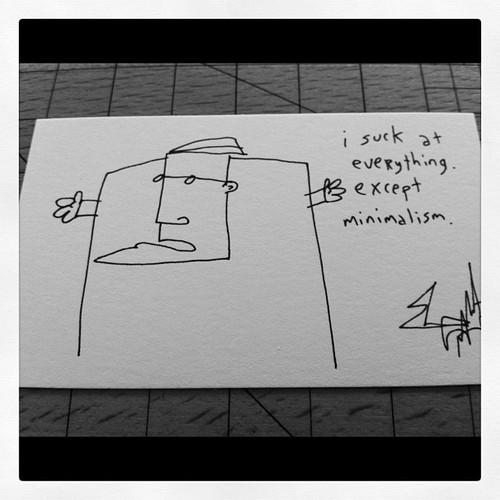
This was another tidbit from Ignore Everybody. In most organizations, not everybody is out to “make a dent in the universe”. Sadly, some people are only there for the paycheck. Their job is just a means to an end, not an expression of anything truly meaningful.
A lot of these people may be smart, nice, happy and productive enough, but be careful letting their worldview seep into yours. One day you’ll look back on your life and realize your life could’ve been so much more than just a stack of pay slips.
But by then it’ll be too late, sadly. By then a big part of you will feel empty inside, and will mourn bitterly forever.
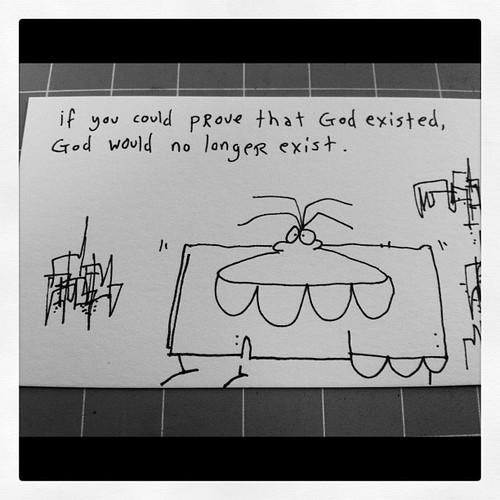
The successful, creative life needs to know clearly where lies the red line, the one that separates what you’re willing to do from what you’re not.
Regardless of what specific compromises one is asked to make in order to pursue one’s dream, the likelihood is that there will be a lot of them; that they will be never-ending.
Personally, I’m more than happy to do work for large corporations, i.e. cartoon commissions. I am unwilling to do work I despise, no matter how much they’re paying. Luckily, I let my clients know this well in advance. It’s give and take.
It's too easy to let the easy path boil your life slowly, like a frog. Choosing not to is harder than it looks. Be forewarned.

This quote by William Butler Yeats is one of my all-time favorites. To paraphrase badly– Savor obscurity while it last, be joyful in the process; you’ll never have that opportunity to create such new work, new life, ever again.
It’s hard to be creative when everybody’s watching you, with everybody expecting ever more unlikely miracles from you. Fame and fortune opens a lot of doors, true, but it’s pretty good at closing some others, as well. Be careful.
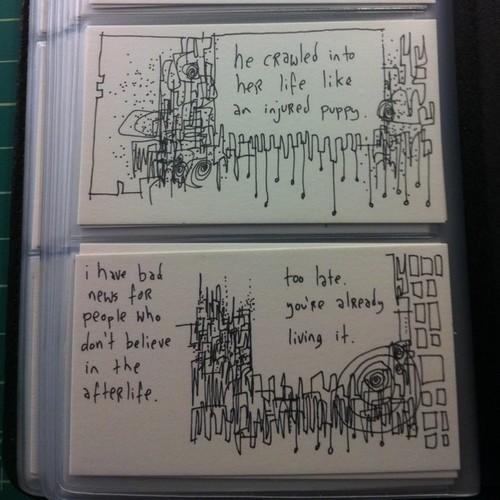
The best way to not suck is to MASTER something useful. Obvious, yes?
“I fell in love with my work and gave my life to it.” — Jiro Ono.
Like everybody else I know, I give a lot of thought to “Success”. What does it take to be successful, prosperous, happy, have a sense of purpose etc? What does THAT actually look like?
And by successful, I don’t mean “lucky”. I don’t mean people born rich, or the lottery winners. That kind of success never comes from within, that kind of success is too external and random to bother worrying about. That kind of success is something you don’t control.
Of course, the media LOVE success models of the outrageously fortunate– celebrity artists, celebrity businessmen, celebrity spiritual leaders, celebrity rich kids, lottery winners, not to mention the Reality TV, famous-for-being-famous crowd.
The thing is, I know TONS of super successful people, but none of them fit this extreme, celeb-lottery-winner-Reality-TV model. Some of them are actually pretty boring, to be honest. But they lead happy, friendly lives and do VERY well career-wise.
THAT is what most success looks like, if you think about it. The stuff on TV or in the movies just isn’t REAL enough for us to learn that much useful stuff from.
So I was thinking about this again, recently, HARD.
What model would work for folk like you and me? A model that didn’t mean you had to sell your soul to Wall Street, Hollywood, Washington or the tabloids? A success model that doesn’t rely solely on the unlikelihood of outrageously good fortune or acts of evil?
Then quite by chance, I saw a great documentary recently: “Jiro Dreams of Sushi”, a film about the world’s greatest sushi master, and a light bulb EXPLODED in my head.
Our man, 85-year-old Jiro Ono is the world’s greatest sushi chef– the only sushi master to ever have been awarded three Michelin stars. He’s also the oldest person to have ever been a recipient of that award.
The thing is, he doesn’t have a lot of money or own a fleet of trendy restaurants in all the world’s capitals, a-la Wolfgang Puck. No syndicated TV shows, celebrity-chef book deals or TV talk-show circuits, either.
He just has just a small, plain, dull, ordinary-looking, low-key sushi bar with ten seats in the basement of a Tokyo office building, near the subway, the kind of nondescript place you’d probably just walk by without stopping, if you saw it. Ten seats! Yet he REALLY IS the best in the world at what he does.
Jiro works seven days a week, over 350 days a year (he hates taking vacation), serves sushi and sashimi to people in very small numbers, and THAT’S IT. Just sushi. No salad, no appetizers, no deserts.
Like I said, JUST SUSHI. And by sticking to this minimalist, barebones formula, he’s become the best in the world.
A tiny little sushi bar in some random subway station. Yet Heads of State eat there, people wait in line, people book a stool at his sushi bar as much as a year in advance, at prices starting around $600 a head. People have been known to fly all the way from America or Europe, just to experience a 20-minute meal. In a basement!
I was lucky enough to have a similar experience first-hand when about eight years ago, I started working with the English Savile Row tailors. They make the best suits in the world; all hand-made, they go for about $5000 a pop.
The tailors have a similar shtick as Jiro. They’re generally not that rich, their businesses are tiny, yet the great and the good worship at their feet. With celebrities, captains of industry, people who are also world-class at what they do, (like Jiro’s customers) waiting as long as a year in advance to get their next suit.
Like Jiro, the tailors just get up every morning and do their thing, day-in-day-out, humbly, quietly, without a lot of fanfare, totally dedicated to their jobs. I’ve seen it. On the surface, it’s quiet, calm and kinda dull.
And like Jiro, from my observations they seem to have this sense of inner satisfaction my Wall Street trader friends (who easily make ten times as much, on a good day) can only dream of.
So as a result, Jiro and the Savile Row tailors are the people I really try to emulate. Because it’s doable. I can do that. I may never be as rich as Steve Jobs or Warren Buffet, I may never be literally a rock star like Bono or Jagger, I may not be as talented as Picasso or Whitman, but I can be like Jiro and the savile Row tailors… or at least, more like them.
So like them, I live quietly, I get up every morning and quietly get on with the business cranking out my product, my cartoons. Like I said, it’s quiet, calm and kinda dull. So what’s their secret? THE secret? What is the secret sauce that lets these otherwise quite ordinary people like Jiro and the tailors, lead such extraordinary lives?
In a word: MASTERY. They’ve MASTERED something. Something interesting and valuable. They are MASTERS of their craft. It may be an old-fashioned word that makes people uncomfortable, but that’s only because it’s something that eludes most people.
Though, having watched these masters carefully first-hand, I can honestly say MASTERY is more satisfying than money. If you’re up for it, yes, MASTERY MATTERS MORE THAN MONEY, MASTERY MATTERS MORE THAN SUCCESS.
And it’s portable. It travels with you, wherever you go. No landlord, no boss, no recession, no round of layoffs, no Wall Street analyst, no newspaper critic can take it away. It’s something that truly belongs to you, for always.
You earned it. It’s yours. Forever.
So when a young person asks me for career advice these days, I tell her, “Don’t worry so much about money, fame, success, rockstardom, whatever. Worry about achieving Mastery– that is something precious you can actually control. And yes, if you’ve truly achieved Mastery, you’re more likely to be successful and prosperous and rockstar, anyway.”
AGAIN, MASTERY MATTERS MORE THAN SUCCESS. So go for it.
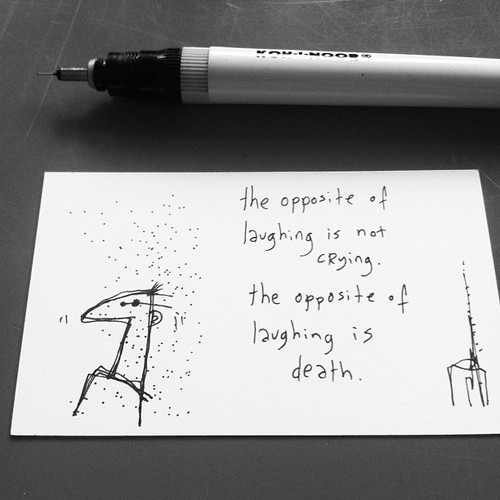
Glasgow artist, David Shrigley is one of my favorite cartoonists. And I have very few of those.
Unlike a lot of my cartoonist heroes (Steinberg, Gorey etc) David can’t draw to save his life, at least, not in the conventional sense. His formal drafting skills (the ones he chooses to show the world, anyway) are just plain bad. I mean, REALLY bad.
And you know what? It doesn’t matter. Actually, it may even be a good thing.
You see, the whole point of Dave’s work is NOT about the drawing. It’s ALL about his ideas.
And his VERY crude drawings work brilliantly for that. In fact, I’d wager that if his drafting skills were more formally developed, his cartoons wouldn’t be nearly as sharp, as interesting or wickedly subversive.
His is a great example of what I like to call “circumventing one’s limitations”. Turning weaknesses into strength. Shrigley is a master of that, he really is.
And yes, I think if you’re to achieve mastery in your craft, your job or your career, you have to learn how to do what David did: Circumvent. You also have to be determined and relentless. David is all that as well, as this interview nicely demonstrates.
Even if you can’t draw to save your life. Even if you didn’t go to the right university. Even if you’re not that good at making money. Even if you have an average IQ. Even if you can’t get venture funding. Even if you weren’t born insanely talented at something. Even if you have to wait tables or bartend for a couple of years.
Circumvent, relentlessly.

INTRODUCING THE 20,000 HOUR RULE… 10,000 TO MASTER THE CRAFT, ANOTHER 10,000 TO MASTER THE BUSINESS.
The 10,000 Hours Rule was made famous by Malcolm Gladwell in his book, “Outliers”.
The book talks about how it takes 10,000 hours working at something to really master it. (10,000 hours means a couple of hours a day for decade, roughly). And he cites people like Bill Gates and The Beatles to prove his case. It’s a good read.
Ten thousand sounds about right to me… though I prefer “The 20,000 Hour Rule”.
It took me 10K hours to get good at cartooning, but then it took me the same amount of time again to figure out the business.
Even then, I still feel I have a long way to go.
It takes about 10 years to become a Savile Row tailor, that is, assuming you have both the talent, the will and the stamina to go the entire apprenticeship. Most kids don’t, which is why the trade is slowly dying out: They can’t find enough young talent to replace the old ones when they retire.
Coincidentally enough, according to the movie, that’s also how long an apprenticeship at Jiro’s lasts.
I once met a master gunsmith from Holland & Holland, the makers of those famously exquisite, $100,000 English hand-made shotguns.
For his first assignment as a young apprentice, he was given a two-inch steel cube and metal file. He was told from the guy training him, that as soon as he could turn the two-inch cube into a one-inch cube, using nothing but his file, he could have his second lesson.
It took him two years to get to Lesson Number Two.
Two years of filing that same damn cube, eight hours day. Until the Master said OK.
It was “Wax-on, Wax-off” for only a couple of days in the movie. The gunsmith apprentice did it for two whole years. Think about it.
Content
Content
Content
Content
Content
Content
Content
Content
Content
Content
Content
Content
Content
Content
Content
Content
Content
Content
Content
Content
Content
Content
Content
Content
Content
Content
Content
Content
Content
Content
Content
Content
Content
Content
Content
Content
Content
Content
Content
Content
Content
Content
Content
Content
Content