Economics by Boundless
Microeconomics
Summary
Macroeconomics
Summary
Microeconomics
Principles of Economics
Summary
The Market System
Summary
Introducing Supply and Demand
Summary
Economic Surplus
Summary
Consumer Choice and Utility
Summary
Elasticity and its Implications
Summary
Market Failure: Externalities
Summary
Market Failure: Public Goods and Common Resources
Summary
Production
Summary
Competitive Markets
Summary
Monopoly
Summary
Monopolistic Competition
Summary
Oligopoly
Summary
Inputs to Production: Labor, Natural Resources, and Technology
Summary
Challenges to Efficient Outcomes
Summary
Taxes and Public Finance
Summary
Income Inequality and Poverty
Summary
Macroeconomics
Introduction to Macroeconomics
Summary
Measuring Output and Income
Summary
Economic Growth
Summary
Inflation
Summary
Unemployment
Summary
Inflation and Unemployment
Summary
Aggregate Demand and Supply
Summary
Major Macroeconomic Theories
Summary
Fiscal Policy
Summary
The Monetary System
Summary
Monetary Policy
Summary
The Financial System
Summary
Current Topics in Macroeconomics
Summary
International Trade
Summary
Open-Economy Macroeconomics
Summary
Economic Crises
Summary
Interest and Profit
Summary
Health Care Economics
Summary
Natural Resource Economics
Summary
Economics of Agriculture
Summary
Immigration Economics
Summary
Principles of Economics
The Study of Economics
The study of economics makes individuals cognizant of their environment and better decision makers.
Economics is a social science that has diverse applications.
Individual Decision Making
When scarce resources are used, actors are forced to make choices that have an opportunity cost.
Individuals face opportunity costs when they choose one course of action over another.
Individuals will choose the option that yields the greatest net marginal benefit.
Incentives are ways to encourage or discourage certain behaviors or choices.
Interaction of Individuals, Firms, and Societies
Summary
Basic Economic Questions
Summary
Economic Models
Summary
Differences Between Macroeconomics and Microeconomics
Summary
Introducing Supply and Demand
Content
Consumer Choice and Utility
Content
Elasticity and its Implications
Content
Market Failure: Externalities
Content
Market Failure: Public Goods and Common Resources
Content
Competitive Markets
Content
Monopolistic Competition
Content
Inputs to Production: Labor, Natural Resources, and Technology
Content
Challenges to Efficient Outcomes
Content
Taxes and Public Finance
Content
Income Inequality and Poverty
Content
Introduction to Macroeconomics
Content
Measuring Output and Income
Content
Inflation and Unemployment
Content
Aggregate Demand and Supply
Content
Major Macroeconomic Theories
Content
The Monetary System
Content
Current Topics in Macroeconomics
Content
International Trade
Content
Open-Economy Macroeconomics
Content
Interest and Profit
Content
Health Care Economics
Content
Natural Resource Economics
Content
Economics of Agriculture
Content
Immigration Economics
Content
The Financial System
Content
The Study of Economics
The Magic of the Economy
- Economics also allows individual agents to balance expectations.
- Economics provides distilled frameworks to analyze complex societal interactions, as in the case of consumer and firm behavior.
- Being knowledgeable about economics foundations allows an individual to be an
active and aware participant rather than a passive economic agent.
-
circular flow
A model of market economy that shows the flow of dollars between households and firms.
-
externality
An impact, positive or negative, on any party not involved in a given economic transaction or act.
Is Economics a Science?
- Economics incorporates both qualitative and quantitative assessment.
- Economics is divided into two broad areas: microeconomics and macroeconomics.
- Economics
can be applied throughout society from business to individual behavior
with further application in the study of crime, family and other social
institutions and interactions.
-
social science
A
branch of science that studies the society and human behavior in it,
including anthropology, communication studies, criminology, economics,
geography, history, political science, psychology, social studies, and
sociology.
- Market
interaction between buyers and sellers is an evaluation of social
behavior in an activity where each agent is seeking to maximize return
and minimize cost.
This is a classic scenario of economics, involving social interaction
(qualitative) with optimization (quantitative).
Individual Decision Making
Scarcity Leads to Tradeoffs and Choice
- Scare resources diminish as they are used and almost all resources are scarce.
- In order to use a scarce resource, you are inherently using the resource for one purpose and not an alternative.
- The
cost of using a resource is called the opportunity cost: the value of
the next best alternative that you could be using the resource for
instead.
-
Scarce
Insufficient to meet demand.
-
Opportunity Cost
The value of the best alternative forgone.
Individuals Face Opportunity Costs
- The opportunity cost is the value of the next best alternative.
- Every decision necessarily means giving up other options, which all have a value.
- The
opportunity cost is the value one could have derived from using the
same resources another way, though this is not always easily
quantifiable.
-
Opportunity Costs
The
value of the best alternative forgone, in a situation in which a choice
needs to be made between several mutually exclusive alternatives given
limited resources.
Individuals Make Decisions at the Margins
- The marginal cost or benefit is the amount that a decision will change the total cost or benefit from where it is currently.
- Individuals will make choice that maximizes the net marginal benefit (marginal benefit - marginal cost).
- While
total or average cost and benefit are important, provided enough
resources, individuals will look only at the net marginal benefit.
-
Marginal cost
The additional cost from taking a course of action.
-
Marginal benefit
The additional benefit from taking a course of action.
Individuals Respond to Incentives
- Price is one of the main incentives studied in economics.
Price incentivizes producers to supply a certain amount, and consumers to purchase a certain amount.
- Economics is mainly concerned with studying remunerative incentives (those that concern material reward).
- Individuals, firms, and governments all change incentives in hopes of encouraging desired outcomes.
-
Incentive
Something that motivates an individual to perform an action.
-
Incentive Structure
The cumulative set of promised rewards and/or punishments that encourage actors to make a set of decisions.
Interaction of Individuals, Firms, and Societies
Content
Basic Economic Questions
Content
Differences Between Macroeconomics and Microeconomics
Content
The Magic of the Economy
The field of economics is a social science.
This means that economics has two important attributes.
Economics
studies human activities and constructions in environments with scarce
resources, and uses the scientific method and empirical evidence to
build its base of knowledge.
Figure 1 Circular Flow of the Economy
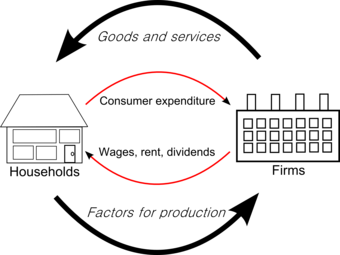
The
evaluation of human interactions as it relates to preferences, decision
making, and constraints is a significant foundation of economic theory.
The
complexity of the dynamics of human motivation and systems has led to
the establishment of assumptions that form the basis of the theory of
consumer and firm behavior, both of which are used to model circular flow interactions within the economy (Figure 1).
Economics provides distilled frameworks to analyze complex societal interactions, as in the case of consumer and firm behavior.
An
understanding of how wages and consumption flow between consumers and
producers provides agents with an ability to understand the symbiosis of
the relationship rather than fixating on the contentious components
that surface from time to time.
Economics also allows individual agents to balance expectations.
An
understanding of the ebb and flow of the economy through the boom and
bust of the business cycles, creates the potential for emotional balance
by reminding agents to limit desperation in downturns and exuberance in
expansions.
By
developing an understanding of the foundations of economics,
individuals can become better decision makers with respect to their own
lives and maintain a balance with respect to an externality that has the potential to supplement or deter their plans.
Since
economic theories are a basis of decision making and regulatory policy,
being knowledgable about economics foundations allows an individual to
be an active and aware participant rather than a passive economic agent.
Is Economics a Science?
Economics is a social science
that assesses the relationship between the consumption and production
of goods and services in an environment of finite resources.
A
focus of the subject is how economic agents behave or interact both
individually (microeconomics) and in aggregate (macroeconomics).
Microeconomics
examines the behavior individual consumers and firms within the market,
including assessment of the role of preferences and constraints.
Macroeconomics analyzes the entire economy and the issues affecting it. Primary focus areas are unemployment, inflation, economic growth, and monetary and fiscal policy.
Figure 1 Founders of Economics
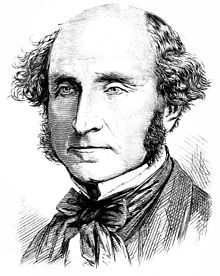
The discipline of economics evolved in the mid-19th century through the combination of political economy, social science
and philosophy and gained entrenchment with the increased scrutiny of
the asymmetric financial and welfare distribution attributed to
sovereign rule.
Early
writings are attributable to Jeremy Bentham, David Ricardo, John Stuart
Mill and his son John Mill and are focused on human welfare and
benefits rather than capitalism and free markets (Figure 1).
As
in other social sciences, economics does incorporate mathematics in the
theoretical and analytics framework of the discipline.
Formal
economic modeling began in the 19th century with the use of
differential calculus to represent and explain economic behavior, such
as utility maximization, an early economic application of mathematical
optimization in microeconomics.
Economics
utilizes mathematics to assess the relationships between economic
actors in environments in which resources are finite.
The
use of mathematics in economics increased the quantitative analysis
inherent in the discipline; however, given the discipline's essentially social science
roots, many economists from John Maynard Keynes to Robert Heilbroner
and others criticized the broad use of mathematical models for human
behavior, arguing that some human choices can not be modeled or
evaluated in a mathematical equation.
Economic theory and analysis may be applied throughout society, including business, finance, health care, and government.
The
underlying components of economic theory can also be applied to variety
of other subjects, such as crime, education, the family, law, politics,
religion, social institutions, war, and science.
Scarcity Leads to Tradeoffs and Choice
A fundamental concept in economics is that of scarcity.
In
contrast to its colloquial usage, scarcity in economics connotes not
that something is nearly impossible to find, but simply that it is not
unlimited.
For example, the number of available hours in a day is a scarce resource: there is a finite amount of time available to you to do work, hang out with friends, and relax.
Most resources are scarce in most situations.
Figure 1 Tradeoffs
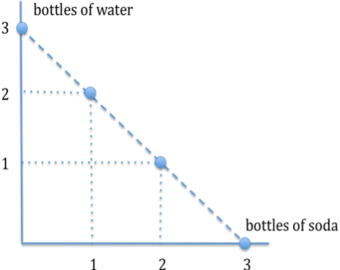
Since resources tend to be scarce, anyone that uses the resource has to make a decision about how to use it.
Suppose, for example, that you are a drink manufacturer.
To produce a beverage, you have to use some scarce resources: the plastic for the bottle, the workers' time, a machine to fill the bottles, etc.
If you choose to make one bottle of water, you have chosen to not make a bottle of soda (Figure 1).
Your scarce resources force you to make a choice and a trade-off producing one product or another.
Like producers, consumers also have to make choices.
Often,
consumer must choose between current consumption ("I want to buy an ice
cream") and future consumption ("I should rather save my money so I can
buy an ice cream tomorrow").
Since
consumers' resources such as time, attention, and money are limited,
they must choose how to best allocate them by making tradeoffs.
The concept of trade-offs due to scarcity is formalized by the concept of opportunity cost.
The opportunity cost of a choice is the value of the best alternative forgone.
In other words, if you can only produce bottles of soda and water, the opportunity cost of producing a bottle of water is the value of producing a bottle of soda.
Similarly, there is an opportunity cost in everything: the opportunity cost of you reading this is what you could be doing with your time instead (say, watching a movie).
When scarce resources are used (and just about everything is a scarce resource), people and firms are forced to make choices that have an opportunity cost.
Individuals Face Opportunity Costs
When individuals make decisions, they are necessarily deciding between taking one course of action over another.
In doing so, they are choosing both what to do and, by extension, what not to do.
The value of the next best choice forgone is called the opportunity cost.
In other words, the opportunity cost of a course of action is the value the option that the individual chose not to take.
Figure 1 Opportunity Cost

Individuals face opportunity costs in both economic and non-economic decisions.
One of the easiest way to imagine an individual's opportunity costs is to imagine a student who decides to study.
By
choosing to study, the student is implicitly choosing to not go to a
party, hang out with friends, or catch up on some much-needed sleep (Figure 1).
In this example, the opportunity cost is not easily expressed in dollars and cents, but is just as real.
Rational individuals will try to minimize their opportunity costs.
By doing so, individuals are maximizing the amount that they can get out of their resources (time, money, effort, etc.).
This makes sense: individuals should seek to get the most and give up the least.
As economic actors, individuals face opportunity costs as well.
For example, suppose you decide to purchase a new computer.
You
could have chosen to spend your money on books or rent or a spring
break trip; whichever one of those options is most valuable to you
(beside purchasing a new computer) is the opportunity cost.
Such
logic applies for every economic decision: purchasing one good means
that an individual has chosen to spend resources one way instead of
another.
Opportunity
costs are an important consideration for economists and busnesspeople,
but are faced by individuals even when they are not making classically
economic decisions.
Individuals Make Decisions at the Margins
Figure 1 Marginal and Total Utility
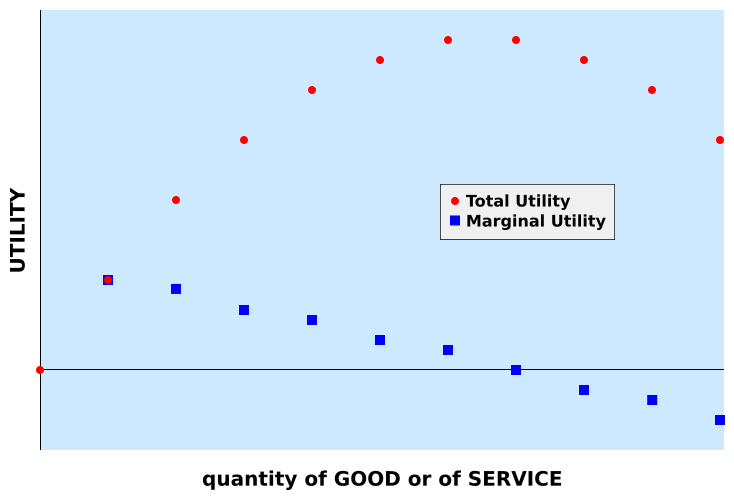
When individuals make decisions, they do so by looking at the additional cost and benefit of the decision.
The cost or benefit of the single decision is called the marginal cost or the marginal benefit.
This is different from the total or average: net marginal benefit (marginal benefit minus marginal cost) is the amount that total benefit will change due to the single decision.
In theory, individuals will only choose an option if marginal benefit exceeds marginal cost (Figure 1).
Let's take an example.
Suppose
you are buying a car and have three choice: Car A, which costs $10,000;
Car B, which costs $12,000; and Car C, which costs $15,000.
The prices represent the marginal costs of each car; purchasing the car will add the cost of the car to your total costs.
Also suppose Car A provides you $15,000 worth of utility, Car B provides $15,000, and Car C provides $25,000.
Those utilities, in dollar terms, are the marginal benefit of each car.
In order to make the decision, you look at the marginal cost and marginal benefit of each car.
By
subtracting the cost from the benefit, Car A offers $5,000 of marginal
benefit, Car B offers $3,000, and Car C offers $10,000.
Obviously, Car C is the best choice because, at the margins, it offers the most benefit to you.
Note
that you care concerned not with your total or average cost and benefit
(assuming no resource or other external restrictions), but with the marginal cost and benefit.
As
a decision maker, you want to know how much the decision will change
your current state, so you look at the margins, not the overall picture.
That
is not to say that things like the total cost are unimportant, but
that, assuming there are enough resources, individuals will look at the
marginal change each option will provide to his/her life or to the firm
and chose the one with the greatest net marginal benefit.
Individuals Respond to Incentives
An incentive is something that motivates an individual to perform an action.
The study of incentive
structures is central to the study of all economic activities (both in
terms of individual decision-making and in terms of cooperation and
competition within a larger institutional structure).
Figure 1 Sales are Incentives

Perhaps the most notable incentive in economics is price.
Price acts as a signal to suppliers to produce and to consumers to buy.
For example, a sale is nothing more than a store providing an incentive to potential customers to buy (Figure 1).
The
lowering of the price makes the purchase a better idea for some
customers; the sale seeks to persuade individuals to change their
actions (namely, to buy the product).
Similarly, the increase in price acts as an incentive to suppliers to produce more of a good.
If suppliers think they can sell their products for more, they will be more inclined to produce more.
The price acts, therefore, as an incentive to customers to buy and suppliers to produce.
Types of Incentives
Incentives come in many other forms, however.
Broadly, most incentives can be grouped into one of four categories:
-
Remunerative incentives: The incentive comes in the form of some sort of material reward – especially money – in exchange for acting in a particular way.
Wages, prices, and bribery are all examples of remunerative incentives.
This is the type of incentive that is typically associated with economics.
-
Moral
incentives: This occurs when a certain choice is widely regarded as the
right thing to do, or as particularly admirable, or where the failure
to act in a certain way is condemned as indecent.
Societies and cultures are two main sources of moral incentives.
-
Coercive incentives: The incentive is a promise of some sort of punishment if the wrong decision is made.
For example, the promise of imprisonment is a coercive incentive for people to not steal.
-
Natural
Incentives: Things such as curiosity, mental or physical exercise,
admiration, fear, anger, pain, joy, or the pursuit of truth, or the
control over things in the world or people or oneself cause individuals
to make certain decisions.
Economics is mainly concerned with remunerative incentives, though, when discussing government regulations, coercive incentives often come into play.
By manipulating incentives, individuals (and businesses and government) hope to encourage some behaviors and discourage others.
Incentives and Performance
Companies
leverage incentives-based strategies to drive performance and optimize
employee decision-making and behaviors through meaningful reward
systems.
While there are both advantages and drawbacks to this type of approach, remunerative (financial) incentives are highly attractive options for employers in a variety of industries and businesses.
Providing incentives
such as variable income, where an individual can obtain more personal
rewards for successfully creating a product or making a sale, often
drives up production for highly motivated employees.
An example of this would be a manufacturing facility making widgets.
The floor manager shifts the wage system from an hourly wage perspective to a straight piece rate system.
Under this system, the more widgets a worker creates the higher his or her prospective income will be.
In
this situation less productive workers may stay the same but highly
productive workers will increase their production as a result of this incentive system.